Matching Cabinet Hardware to a Marble Benchtop
Choosing hardware to sit with natural stone — how to read undertone, when to pair stone with stone, and why the benchtop should lead.

Match the undertone, not the colour. A benchtop with warm veining — cream, gold, rust, soft brown — sits with brass, aged bronze and brushed copper. A benchtop with cool veining — grey, blue, charcoal, green-grey — sits with gunmetal, brushed steel and matte black. Test against the stone itself rather than a photograph of it, because natural stone shifts considerably under different light.
Beyond that, there is a second decision most people do not consider: whether the hardware should be metal at all.
Read the veining, not the background
Almost every natural stone is described by its background colour. Carrara is white. Garish (Verde Alpi) is green.
The background is rarely what drives the decision. The veining is.
A white marble with warm grey veining and a white marble with blue-grey veining will take entirely different hardware, despite being described identically. Stand close, look at the thinnest veins, and identify whether they pull warm or cool. That is the undertone the hardware has to answer.
If the stone reads as neither — a true neutral — you have latitude. Use it.
Contrast or continuity
Two approaches, both valid.
Continuity. The hardware disappears into the palette. A warm-toned stone with brass hardware and warm timber joinery reads as a single material family. The room feels resolved and quiet. This is the safer approach, and the one that ages best.
Contrast. The hardware is the point of tension. Gunmetal against a warm-veined marble, or brass against a cool grey, creates a deliberate break. It reads as a decision rather than a default.
What does not work is the accidental middle — a finish that is neither clearly aligned nor clearly opposed. That is where hardware looks like it was chosen from whatever was available.
Our guide to the seven Ensemble finishes sets out how each one reads.
Stone against stone
The less obvious option: stone hardware on a stone benchtop.
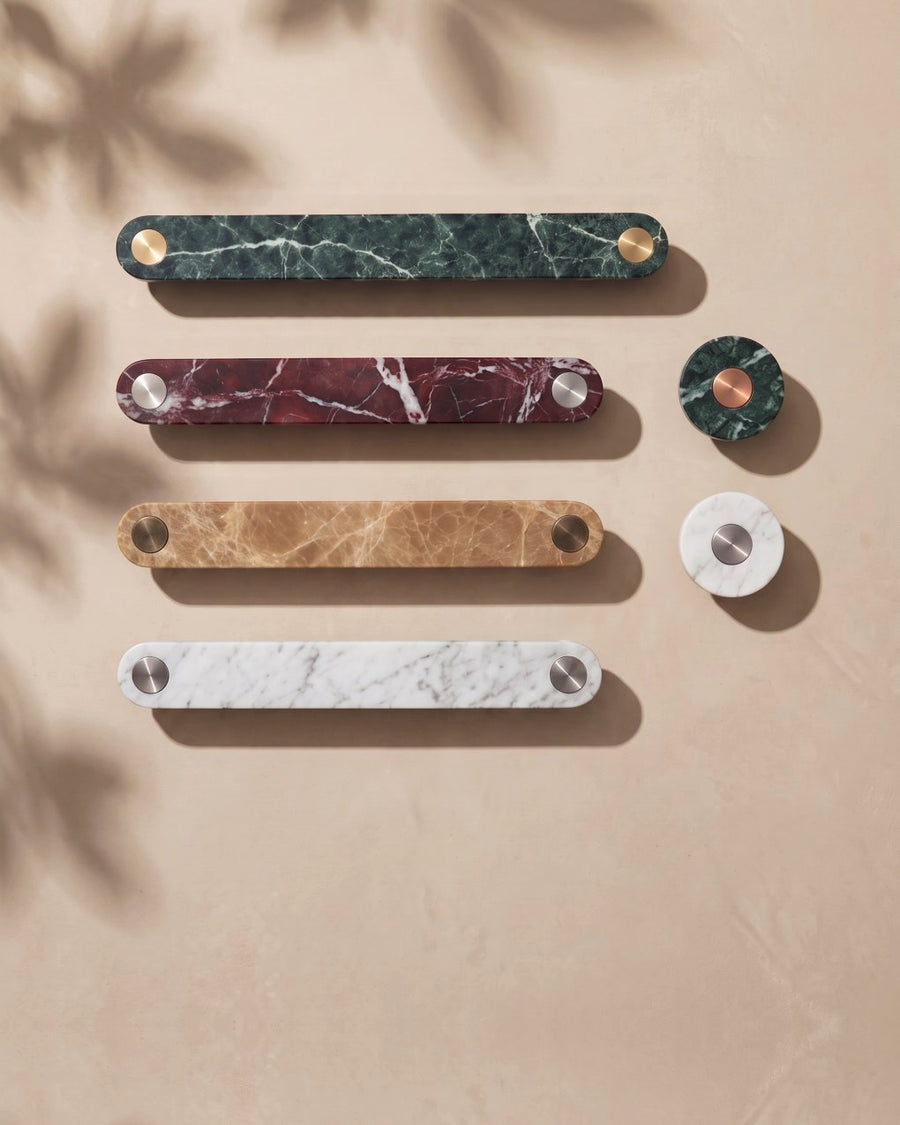
It is more subtle than it sounds, because the two stones do not need to match. A Garish (Verde Alpi) handle against a white marble benchtop is not a clash — it is the same material language in a different register. The tactile quality is consistent even when the colour is not.
A few rules from experience.
Do not attempt an exact match between a handle and a benchtop unless both were cut from the same block. Natural stone varies within a single slab, let alone between quarries. A near-match reads as a failed match, where a deliberate difference reads as intent.
Do consider the benchtop’s own veining density. A heavily figured stone competes with a figured handle. Against busy stone, a quieter handle body in timber or a solid metal finish will usually sit better.
Where tapware fits
Hardware is not chosen in isolation. In a kitchen, it sits alongside tapware, and the two are the most visible metal elements in the room.
The standard advice is to match them. It is reasonable advice, and it is also the reason so many kitchens feel flat.
A more useful rule: sixty-thirty-ten. One metal carries around sixty per cent of the visible fittings, a second takes roughly thirty per cent in a defined role, and a final ten per cent acts as an accent — ideally a callback to a material already in the room. Two metals with a clear hierarchy read as considered. Three in equal measure do not.
We have written more on this in our guide to mixing metal finishes in a kitchen.
Test in the room
Stone changes under light more than any other interior material.
A marble sample viewed in a showroom under downlights and the same slab viewed in a north-facing kitchen at four in the afternoon are effectively different materials. Veining that read as grey turns green. Warmth that seemed obvious disappears.
Which means hardware decisions made against a photograph, a supplier’s swatch card or a screen are decisions made against the wrong information.
Put the actual stone and the actual finish together, in the actual room, at two different times of day. It is the only reliable test.
Deciding later
There is a sequencing problem built into most renovations.
The benchtop is usually selected early, sometimes before the joinery colour is final and almost always before the room exists. Hardware is selected last, under time pressure, against a palette that has shifted since the stone was chosen.
The fix is to hold the hardware decision until the stone is in front of you. Bring a sample of the benchtop, or a large offcut, and test the handle and its button finish against it in the room, in the light it will actually live in. Our guide to when to choose hardware in a renovation sets out the sequence in full.
Common questions
What colour handles go with a marble benchtop?
Match the undertone of the veining rather than the background colour. Warm veining suits brass, aged bronze and brushed copper. Cool veining suits gunmetal, brushed steel and matte black.
Should cabinet hardware match the tapware?
Not necessarily, but there should be a clear hierarchy. A sixty-thirty-ten split works: one metal across most visible fittings, a second in a defined role, and a small accent that references another material in the room.
Can you use marble handles with a marble benchtop?
Yes, and they do not need to match. A deliberate difference in stone reads as considered, where a near-match reads as a failed attempt to match. Avoid figured handles against heavily figured benchtops.
Does brass work with grey marble?
It can, as contrast rather than continuity. Against cool-toned stone, brass is a deliberate break in the palette. It works when it is the only warm element and it is used consistently.
How do I test hardware against my benchtop?
Hold the actual finish against the actual stone, in the room, at two different times of day. Natural stone shifts significantly under changing light, and screens and printed swatches do not reproduce it accurately.
Related reading
- A Guide to Cabinet Hardware Finishes
- Mixing Metal Finishes in a Kitchen
- Caring for Marble, Timber and Metal Cabinet Hardware
The benchtop is the largest natural material in most kitchens. It should lead, and the hardware should answer it.
Sloan Roberts marble comes in four stones: White (Carrara, Italy), Latte (Emperador Light, Turkey), Red (Rosso Levanto, Turkey) and Green (Garish, also known as Verde Alpi, Italy). Each piece is assembled in Melbourne, and marble bodies run from the 40mm knob through to 192mm centres.
Materials, handled.
— David & Nigel