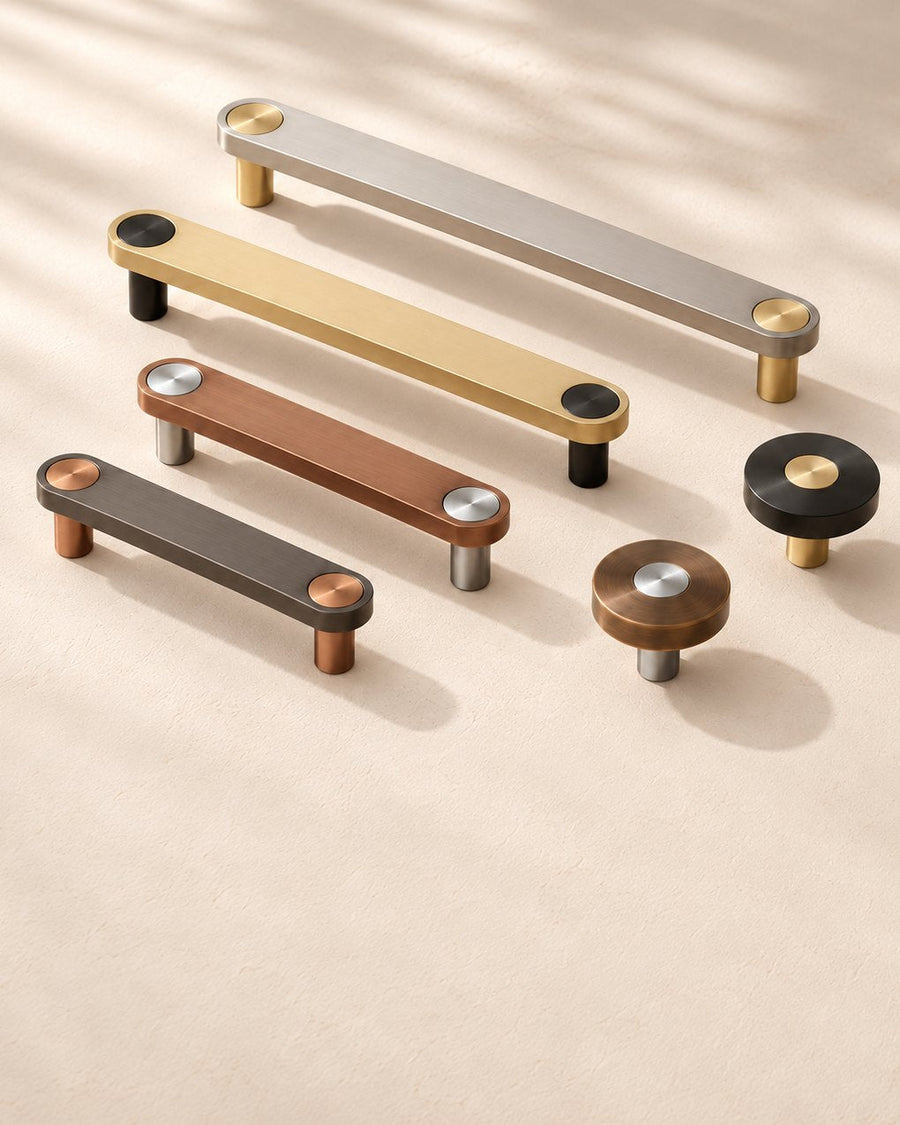
Cabinet Handle Sizing: 128, 160, 192 or 224mm Centres?
How to choose cabinet handle size — centre-to-centre explained, what suits each drawer width, and how to compose hardware across a whole room.

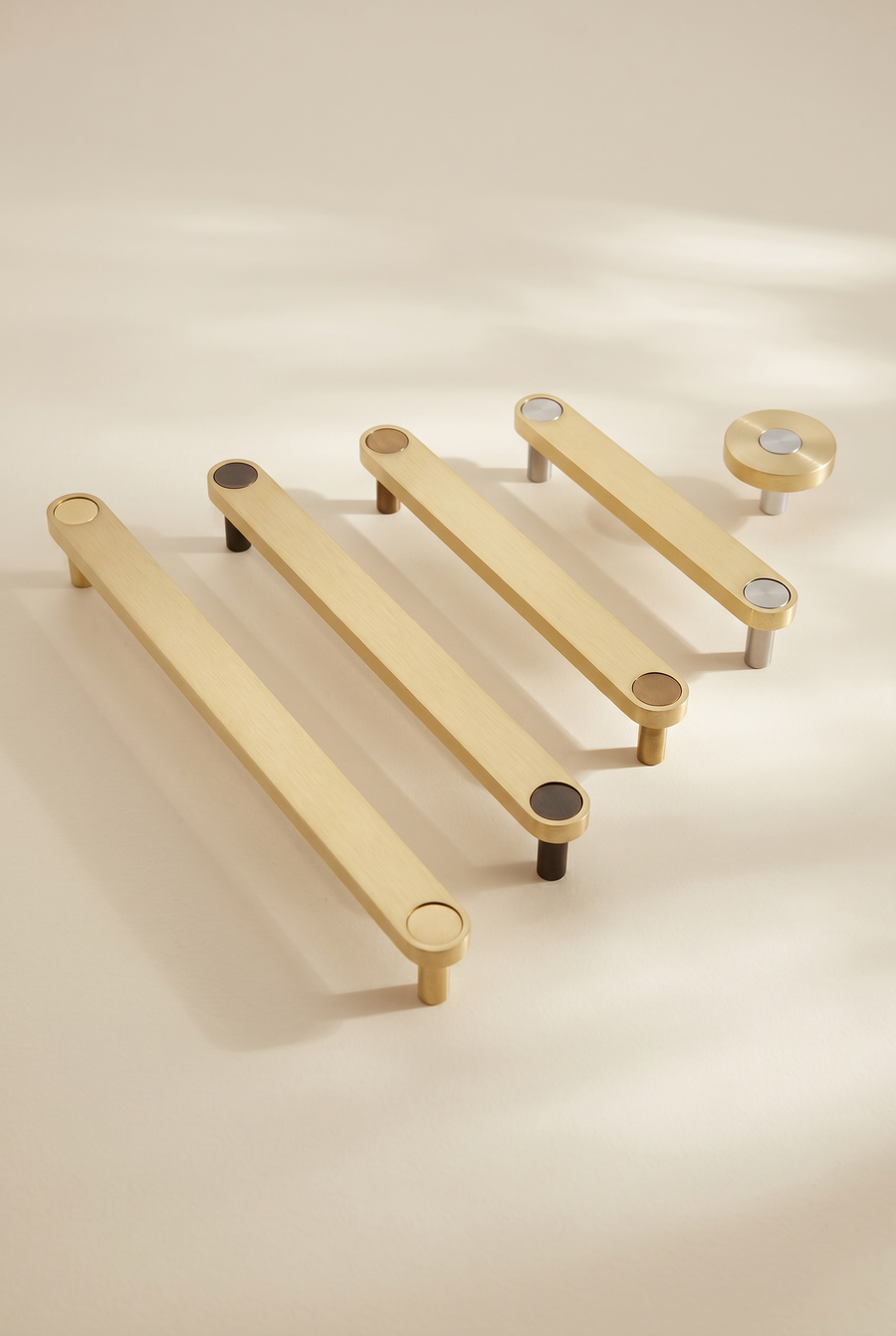
As a starting point: a 40mm knob suits cabinet doors and drawers under roughly 400mm. Use 128mm centres between about 400 and 550mm, 160mm between 550 and 700mm, 192mm between 700 and 900mm, and 224mm from 900mm up — pantry fronts, appliance panels, full-height joinery. If you are replacing existing handles, your current hole centres decide the size for you.
That is the short answer. The rest of this guide covers how to measure, what the numbers mean, and how to compose hardware across a whole room.
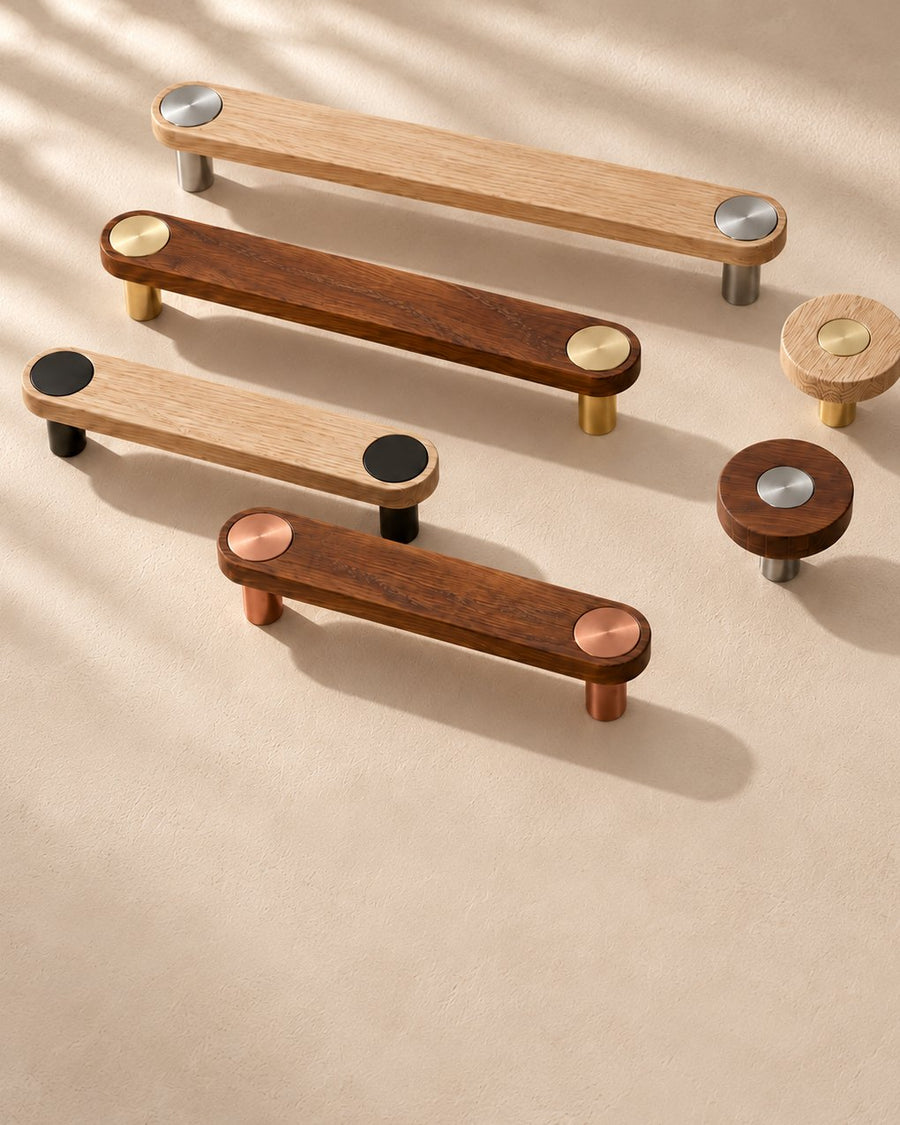
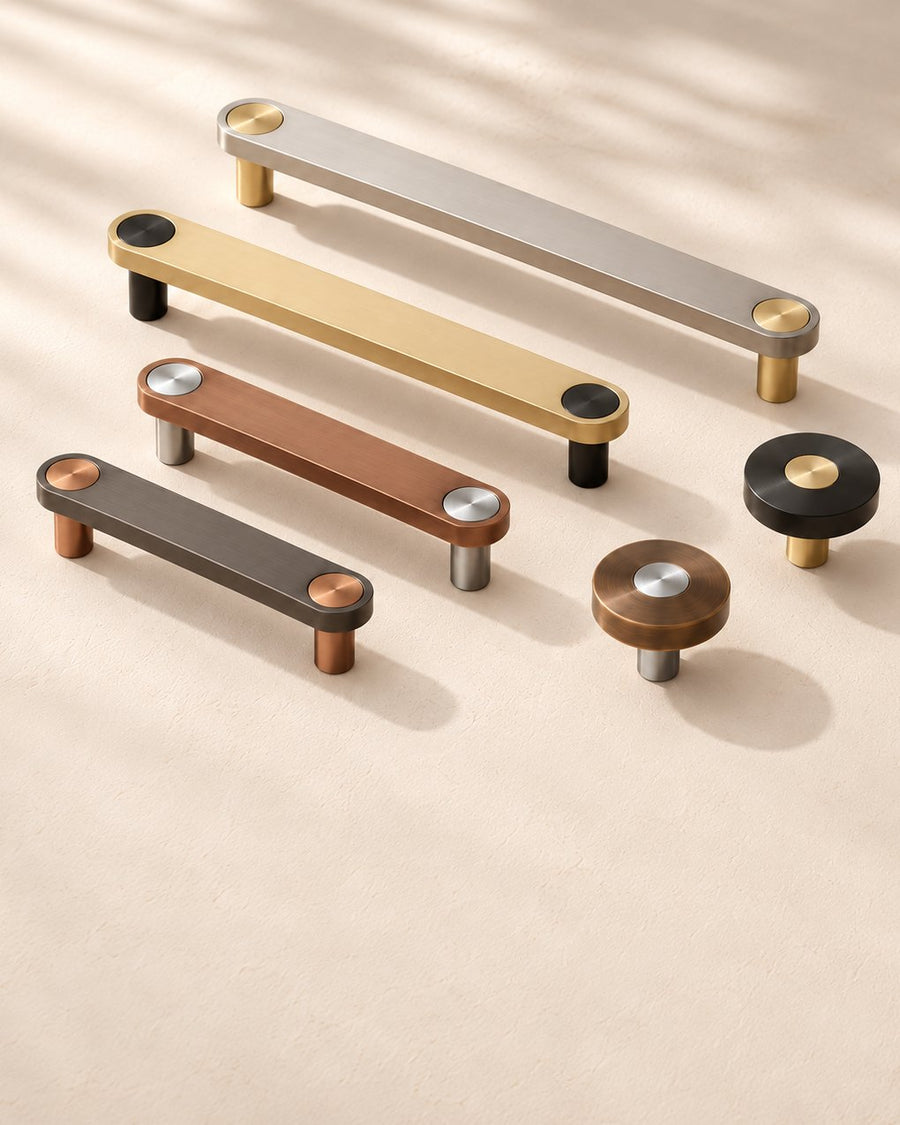
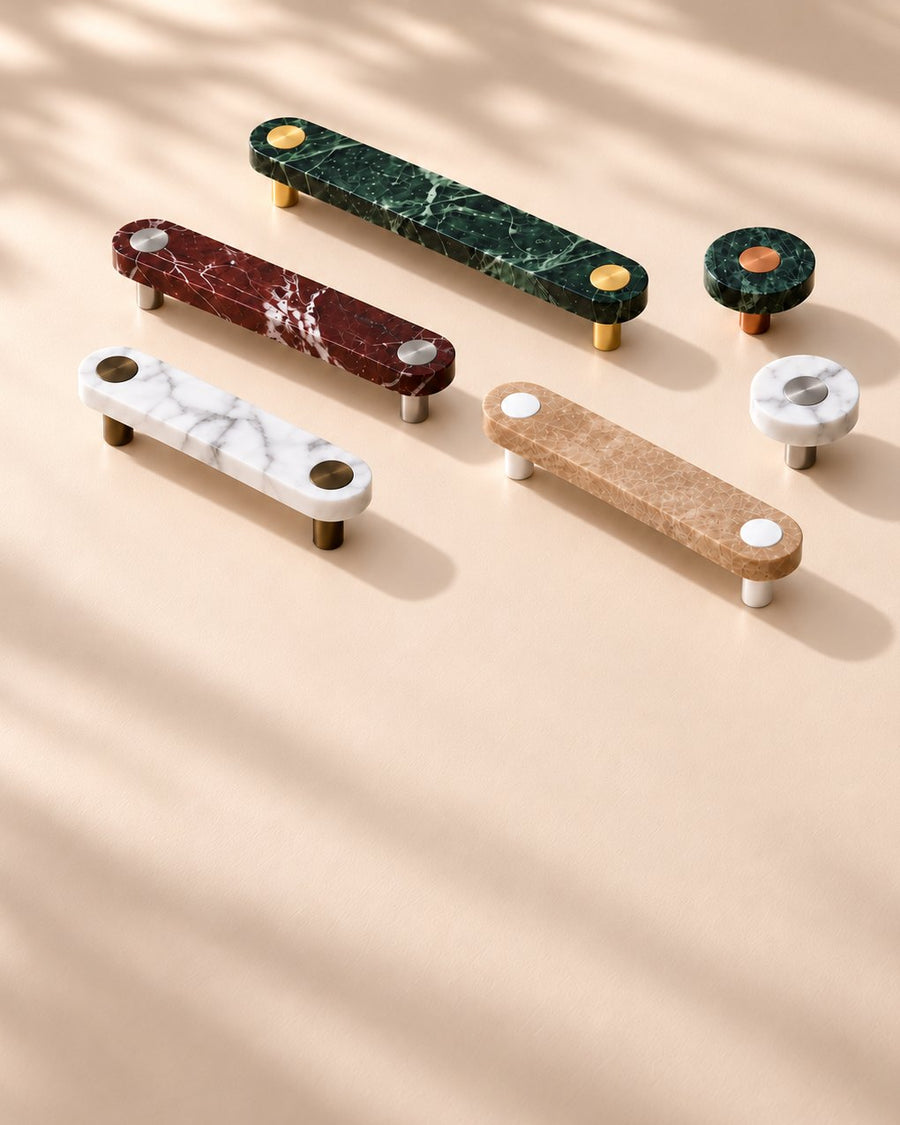
One note on range: 224mm centres are available in metal and timber. The marble bodies run from the 40mm knob through to 192mm centres, because of how the stone behaves at length. On a very wide marble-fronted drawer, two handles at 192mm will read better than one oversized piece.
Centre to centre
Centre to centre — often written as CC — is the distance between the middle of one screw hole and the middle of the other.
It is not the overall length of the handle. A 160mm handle is longer than 160mm end to end, sometimes considerably. Ordering by overall length is the most common sizing mistake we see, and it is the one that cannot be corrected after the holes are drilled.
Every Ensemble product page lists centres in millimetres and inches, alongside overall length and projection, so the two figures can never be confused.
Measuring existing cabinetry
If you are updating hardware on cabinetry that is already installed, measure before you choose anything.
Remove one handle. Measure from the centre of one hole to the centre of the other. That measurement is your centre size, and it is fixed unless you are prepared to fill and re-drill.
Most Australian cabinetry built to standard specifications will return a figure that matches a common centre size. If your measurement falls between two sizes, the cabinetry was likely drilled to an imperial spacing or built to a bespoke template. Our guide to System 32 explains why the standard sizes are what they are.
Proportion
For new cabinetry, where the holes have not yet been drilled, sizing becomes a question of proportion rather than fit.
A useful guide: a handle reads well at roughly one third the width of the drawer front. It is a starting point, not a rule. A wide, shallow drawer can carry a longer handle than the ratio suggests. A tall, narrow drawer often looks better with less.
The ratio is there to stop two things — a handle that looks lost on a large front, and one that dominates a small one.
Between two sizes, take the larger one. People choosing hardware without a physical reference in front of them almost always err small, because a handle viewed in isolation reads bigger than the same handle does once it is mounted with the full cabinet around it. A pull that looks slightly too long on screen is usually the one that looks right on the drawer.
Past about 1100mm, a single handle stops working regardless of size. Use two, set at the third points of the front.
Sizing across a room
A kitchen usually contains drawers of several widths. Handles sized strictly to each one will read as accidental.
Two approaches work.
One size per zone. All base drawers take the same centre size, regardless of width. Overheads and doors take knobs. The eye reads the rhythm rather than the individual pieces.
Scale with width. Handle size steps up as drawer width increases. This suits kitchens with a wide spread of drawer sizes, where a single size would look wrong at both ends.
Pick one and apply it consistently. Mixing the two approaches in a single room is what makes hardware feel unresolved.
Sixty, thirty, ten
Interior designers have long used a sixty-thirty-ten split to distribute colour through a room. Sixty per cent carries the scheme, thirty per cent supports it, and ten per cent breaks it.
The same proportions work for hardware, and they are more useful here because hardware is repeated. A kitchen might hold thirty handles. How they are distributed is a composition, whether it was composed or not.
Sixty per cent — the field. One size, one material, one finish, across the majority of the joinery. This is the part that should not ask for attention. Consistency here is what allows anything else to register.
Thirty per cent — the shift. A second size or material, applied to a defined group. Overhead doors. The island. The butler’s pantry. It has to be a group, not a scattering.
Ten per cent — the callback. One element, deliberately different. A single run of drawers, a bar, a bank of wardrobe doors.
The proportions matter less than the hierarchy. What the rule prevents is the even split — half the room in one thing and half in another — which reads as indecision rather than contrast.
The callback
The ten per cent is where hardware stops being a fitting and starts doing something in the room.
Used well, it is a callback: a small, deliberate echo of a material that already exists in the space. A Garish (Verde Alpi) marble knob on a bar cabinet, picking up green in the splashback. An oak pull on a single run of drawers, answering the timber floor. A brushed copper button on the island, repeating a copper pendant three metres above it.
None of these will be noticed individually. That is the point. Nobody walks into a kitchen and remarks on a handle.
What they notice is that the room holds together — that the materials appear to have been chosen in relation to one another rather than selected from separate catalogues. The callback is doing that work quietly, at the scale of a few centimetres, repeated in the places where a hand actually lands.
Three conditions make it work.
The material has to already be in the room. A callback references something. A material introduced only through the hardware is not a callback, it is a fourth material.
It has to be small enough to be missed. If the accent is thirty per cent of the hardware it is no longer an accent, it is a second scheme.
It has to sit where it makes sense. The island, the bar, the entry joinery — places already treated differently in the cabinetry. An accent applied to an arbitrary cupboard reads as a mistake, not a decision.
Knobs and pulls
A knob is gripped between finger and thumb. A pull is gripped with the whole hand.
That difference matters on heavy drawers. A deep pot drawer, fully loaded, is easier to open with a pull. A light cabinet door is fine with a knob.
The common convention is knobs on doors, pulls on drawers. It is worth following in most kitchens, and worth breaking in a wardrobe or bathroom where the loads are lighter and the composition matters more than the mechanics.
Metric and imperial
Australian cabinetry is built in metric. Much of the hardware literature is American, and written in inches.
| Centres | Imperial | Available in |
|---|---|---|
| 128mm | 5″ | Metal, timber, marble |
| 160mm | 6¼″ | Metal, timber, marble |
| 192mm | 7½″ | Metal, timber, marble |
| 224mm | 8⅞″ | Metal and timber |
The conversions are close but not exact. If you are working from an American source, convert to millimetres before measuring. Full dimensions are set out in our Sizing Guide.
Before you order
Mark the centre measurement onto a strip of masking tape and stick it to the drawer front, at the height the handle will sit.
It takes a minute, and it shows the proportion at full scale in the actual room, under the actual light. A drawing cannot do this. Neither can a product photograph.
One decision you can revisit
Size is permanent. Once the holes are drilled, the centres are set.
Finish is not. Every Ensemble handle is built from a body and an interchangeable button detail, which means the metal finish can be changed later without replacing the handle or touching the cabinetry.
Common questions
What is the most common cabinet handle size?
160mm centres is the most widely used size in Australian kitchens, because it suits the drawer widths most commonly built into base cabinetry. 128mm is the most common size in bathrooms and smaller joinery.
How do I measure cabinet handle size?
Measure from the centre of one screw hole to the centre of the other. This is the centre-to-centre measurement, and it is the figure used to order. Do not measure the overall length of the handle.
Can I replace my handles with a different size?
Only if the centre measurement matches. A different size requires new holes, which means filling and refinishing the existing ones. Measure your current centres first.
Should all handles in a kitchen be the same size?
Not necessarily, but they should follow a hierarchy. A sixty-thirty-ten split works well: one size and material across most of the joinery, a second across a defined group, and a small accent that references another material in the room.
What size handle for a 900mm drawer?
224mm centres in metal or timber. In marble, where the range tops out at 192mm centres, use two handles set at the third points of the front. Past about 1100mm, use two handles in any material.
Related reading
- What Is System 32, and Why It Matters When Choosing Handles
- Where to Position Cabinet Handles
- A Guide to Cabinet Hardware Finishes
Sizing is one of the few hardware decisions that cannot be undone. It is worth measuring twice — and because Ensemble handles are made to order, they are not returnable for change of mind, so the masking tape test is time well spent.
Every piece is made to order and assembled in Melbourne. Handles are rear-fixed and supplied with M4 × 22mm and M4 × 45mm break-off cabinet handle screws to suit a range of door and drawer front thicknesses.
Materials, handled.
— David & Nigel